
// CASE STUDY
Playbeat 4
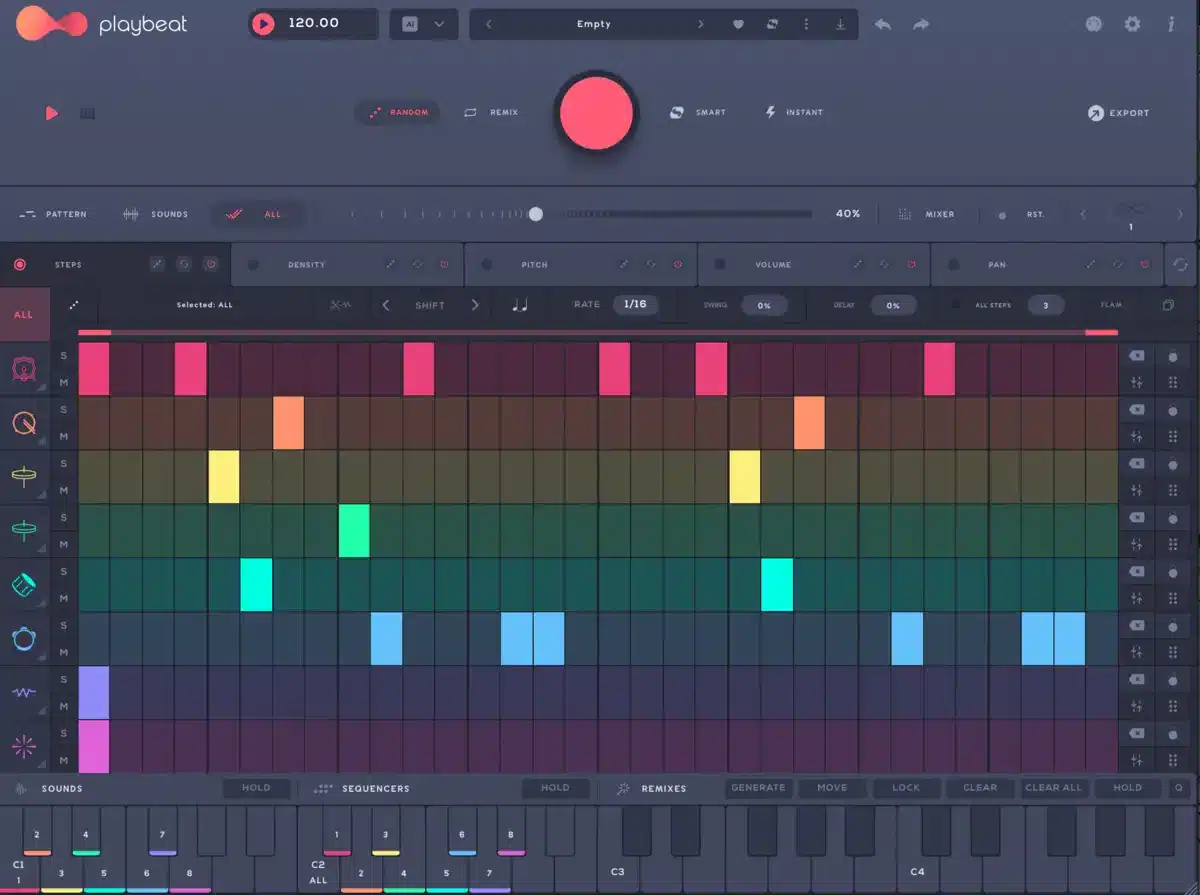
Playbeat 4 is Audiomodern's AI-powered drum designer, released on 5 March 2025 as VST3, AU, AAX, AUv3, and standalone for Windows, macOS, and iPadOS. Atlantic Audio Development built the full application and its sequence randomization engine in JUCE and C++, including the iPadOS in-app purchase flow.
CLIENT: AUDIOMODERN
Published with Audiomodern's permission. Our engagements are confidential by default, and most of our work stays unnamed.
// THE BRIEF
Generate the pattern and pick the sounds
Audiomodern wanted the fourth generation of Playbeat to write drum patterns and choose the sounds that play them. Playbeat 3 already randomized steps inside a sequencer the user set up by hand. Playbeat 4 had to add genre-aware generation of both patterns and kits, a performance keyboard, a sample editor, a mixer and a tagged preset manager, and run on iPad as well as in a desktop DAW.
Audiomodern put roughly two years into the release. Playbeat 4 shipped on 5 March 2025.
// OUR RESPONSIBILITY
Who built Playbeat 4?
Atlantic Audio Development built the full application and the sequence randomization engine in JUCE and C++. That covered the sequencer core, the generation layer, the editor, and every plugin and standalone target on desktop and iPadOS. On iOS we also built the in-app purchase system for buying and downloading expansion packs. We had already worked on Playbeat 3, so the engagement started from a product and a codebase we knew.
Audiomodern owned product direction, sound design and the 1500 factory kits. We owned the software.
// CONSTRAINTS
Eight sequencers, six build targets, one engine
- Eight sequencers run at once, each with its own rate, swing and delay, and each step carrying its own density, pitch, volume and pan.
- In Infinity Mode a new pattern is generated on every loop, so generation has to land without interrupting playback.
- The same engine ships as VST3, AU, AAX and standalone for Windows and macOS, as AUv3 and standalone for iPadOS, and as a MIDI FX plugin for Logic Pro.
- AUv3 runs in an app-extension sandbox with its own memory budget and file-access rules, which constrains sample import, preset storage and export.
- On iPad, touch is the only pointer, and the desktop layout still has to stay dense enough for mouse editing.
- macOS builds support 10.14 upward including native Apple Silicon; Windows builds target 10 and later; the iPad app targets iPadOS 12 and later.
// ARCHITECTURE & APPROACH
How does pattern generation stay off the audio thread?
Pattern generation writes parameters, so it sits above the sequencer core. The generator fills the same step model the user edits by hand, which is why a generated pattern can be tweaked step by step straight afterwards. Complexity and SMART mode act as constraints on what the generator may produce, so the result lands inside the musical range the user chose.
The sequencer engine keeps a realtime-safe core: no allocation, no locks and no file access in the processing callback. New patterns and new sound assignments reach the audio thread through preallocated state that it picks up between blocks, which is what makes Infinity Mode viable on every loop. The engine runs the same way whether the host is Ableton Live, Logic Pro or the standalone app.
One codebase covers all six targets. Platform differences sit behind a thin abstraction layer: file access, preset and pack locations, drag-and-drop sample import, and the MIDI and audio export paths all behave differently on desktop, inside the AUv3 sandbox and in the standalone iPad app. The preset and pack manager also reads Playbeat 3 expansions, so existing libraries load into Playbeat 4. The interface scales from touch targets on iPad to the denser desktop layout from one set of components.
// WHAT SHIPPED
Playbeat 4, 5 March 2025
Audiomodern released Playbeat 4 as VST3, AU, AAX and standalone for Windows and macOS, AUv3 and standalone for iPadOS, and a MIDI FX version for Logic Pro. The desktop builds support macOS 10.14 or later with native Apple Silicon, and Windows 10 or later. The iPad app is a free download with a $29.99 unlock and needs iPadOS 12 or later.
The shipped feature set includes eight independent sequencers with per-step steps, density, pitch, volume and pan and per-track rate, swing and delay; genre-based randomization of patterns and sounds across up to three of 35 genres with a Complexity control; Infinity Mode and SMART mode; a multi-functional performance keyboard; drag-and-drop sample import with a sample editor, mixer and filter; a tagged preset and pack manager; MIDI and audio export; and 1500 factory kits.
// POST-RELEASE RECORD
Is Playbeat 4 still maintained?
Playbeat 4 has been updated on a fast cadence since launch. Version 4.0.0 arrived on 5 March 2025 and reached 4.0.9 by June 2025. Version 4.2.0 added an FX section on 21 May 2026, and 4.2.2 followed on 2 June 2026. Audiomodern's update log records crash fixes, a resolved AUv3 export crash, a fix for a performance keyboard freeze, and refinements to the sequencer engine for stability and performance.
The engineering outcome we were hired for: improved performance and stability across complex sessions, reduced CPU spikes, and crashes eliminated in high-load scenarios. Plugin Boutique lists Playbeat 4 at 4.6 out of 5 from 165 ratings.
// PRESS
What reviewers said
"With Playbeat's new features, you're just 6-7 clicks away from an endless supply of creative, customizable patterns—what's not to love?"
"The AI-powered features feel like having a creative collaborator rather than just another tool."
// WHAT WE DELIVERED
Scope of our work
Full application development. We built the Playbeat 4 application in JUCE and C++, from the sequencer core to the editor and the preset and pack manager.
Sequence randomization engine. We implemented the generative layer behind genre-based pattern and sound randomization, the Complexity control, SMART mode and Infinity Mode.
Cross-platform targets. We delivered VST3, AU, AAX and standalone builds for Windows and macOS, AUv3 and standalone for iPadOS, and the Logic Pro MIDI FX variant from one codebase.
iOS in-app purchases. We built the StoreKit-backed purchase flow on iPadOS: the $29.99 full unlock and buying and downloading expansion packs inside the app.
Continuity from Playbeat 3. We carried our earlier Playbeat 3 work forward, including import of Playbeat 3 expansion packs into the new preset manager.
Performance and stability. We improved performance and stability across complex sessions, cut CPU spikes and eliminated crashes in high-load scenarios.
// RELATED SERVICES